Resource
Advancing Causal Effect Estimation for Real-World Decision-Making: Dr Hechuan Wen’s Journey
How can organisations make informed decisions when the data available are limited, changing, or incomplete? This question became the focus of CIRES PhD graduate Dr Hechuan Wen’s thesis, Advancing Ca ...
Advancing Causal Effect Estimation for Real-World Decision-Making: Dr Hechuan Wen’s Journey
How can organisations make informed decisions when the data available are limited, changing, or incomplete?
 This question became the focus of CIRES PhD graduate Dr Hechuan Wen’s thesis, Advancing Causal Effect Estimation: From Training Data Expansion to Estimator Design, supervised by Associate Professor Rocky Chen, Professor Hongzhi Yin, Dr Li Kheng Chai, and Professor Shazia Sadiq.
Rather than simply predicting what is likely to happen, Hechuan studied how AI can estimate what would happen to an individual or community under a particular intervention, such as a healthcare policy, treatment, or public service. His research focused on making causal effect estimation more reliable and practical when real-world data are imperfect. Specifically, he addressed three key challenges: identifying the most informative data when labelling resources are limited; maintaining reliable estimates when data distributions change or important variables become unavailable; and quantifying uncertainty when causal effects are estimated from complex, interconnected data.
This focus on developing data-efficient, robust, and uncertainty-aware methods aligns closely with the goals of Information Resilience, supporting more reliable decision-making when information is incomplete or changes over time. The research was shaped by both Hechuan’s master’s research and his collaboration with Health and Wellbeing Queensland. Through this work, he became increasingly aware of the importance of data-informed decision-making and how evidence may support it. This motivated him to develop causal AI methods that are not only accurate, but also data-efficient, robust, uncertainty-aware, and more useful for real-world decision-making.
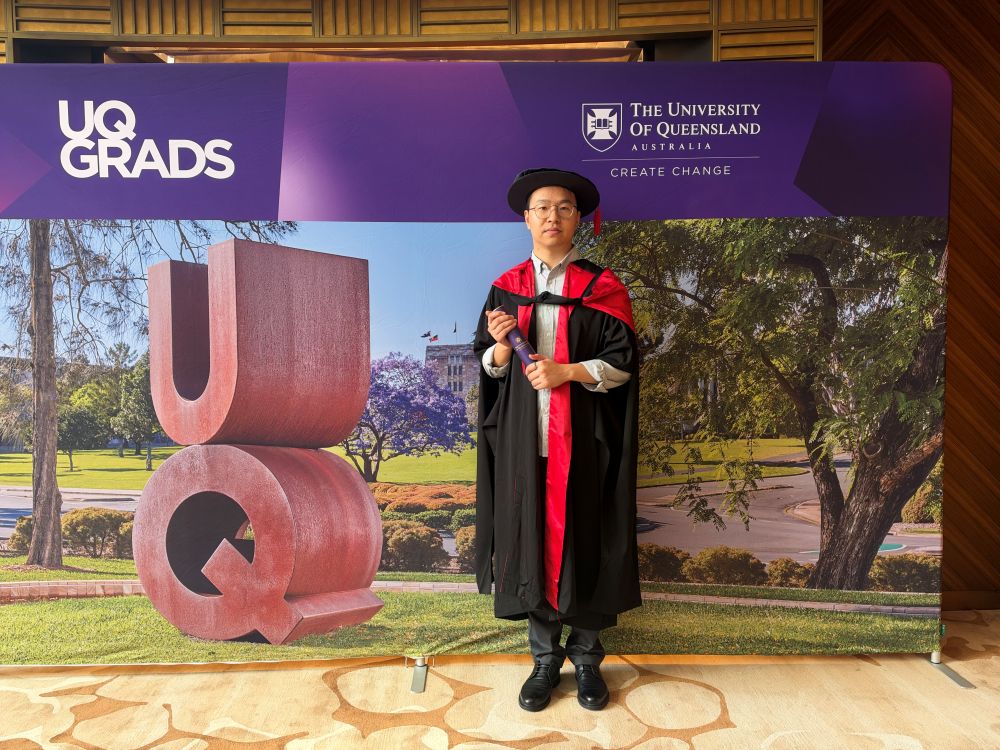
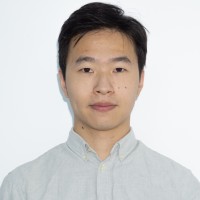
Pictured above: Dr Hechuan Wen, UQ Graduation Day in Shanghai, October 2026.
Bringing Causal AI into Practice
A key part of Hechuan’s PhD experience was a 12-month placement with Health and Wellbeing Queensland. Working closely with health and data specialists provided an opportunity to connect methodological AI research with practical challenges in preventive health, including understanding wellbeing issues across urban, rural, and remote communities.
The placement also created an opportunity for knowledge exchange between researchers and practitioners. For Health and Wellbeing Queensland, the collaboration provided exposure to emerging causal inference and AI methodologies, helping build understanding of both their potential applications and their practical limitations in public health settings.
Reflecting on the experience, Hechuan said:
“One of my most important learnings was to begin with the decision problem rather than with the algorithm. In academic research, it is easy to focus primarily on model performance or technical novelty. Through the placement, I learned that a useful solution must also reflect practical constraints such as limited and fragmented data, the cost of collecting labels, privacy requirements, health inequities, and differences between the populations represented in training data and those encountered in practice.” Dr Hechuan Wen, The University of Queensland.
Creating Value Through Collaboration
The collaboration provided benefits for both the research and practice communities. While Hechuan gained valuable insight into the challenges of working with real-world health data and decision-making processes, Health and Wellbeing Queensland had the opportunity to engage with emerging methods for estimating intervention effects and explore how these approaches may support future evaluation activities. The project also fostered stronger connections between researchers and practitioners, creating opportunities for ongoing future collaboration.
While translation of the research into practice remains a longer-term goal, the collaboration has increased understanding of advanced data science methodologies and contributed to building knowledge that may inform future approaches to evidence generation and evaluation, to improve preventative health.
Reflecting on Hechuan’s contributions, Partner Investigator and Associate Supervisor from Health and Wellbeing Queensland Dr Li Kheng Chai said:
“Hechuan is a dedicated, thoughtful, and approachable researcher, who works well in a collaborative environment. His research has increased our awareness of advanced data science methodologies and their potential applications in preventive health. We are confident that Hechuan will continue to make significant contributions to his field and beyond. Working with researchers gave us an opportunity to better understand both the strengths and limitations of these emerging methodologies and consider where they may be useful in future public health applications.” Dr Li Kheng Chai, Health and Wellbeing Queensland.
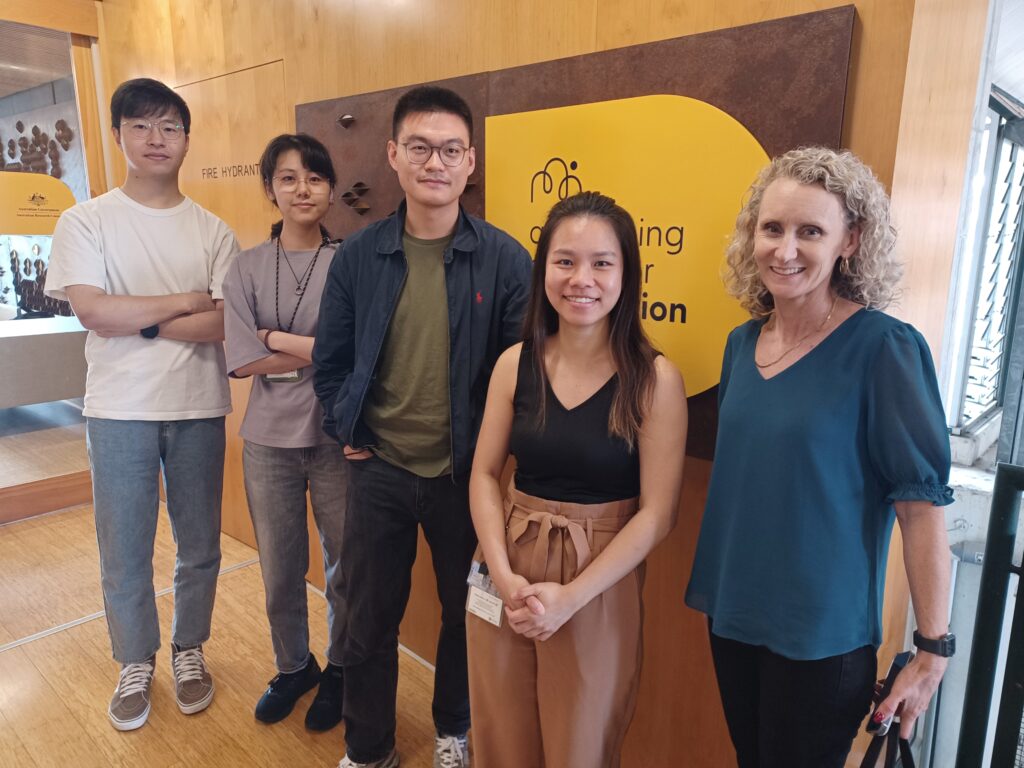
Pictured above: Project Team workshop at CIRES Headquarters, December 2024. L to R: Dr Hechuan Wen, Dr Zixin Wang, Associate Professor Rocky Chen (UQ), Dr Li Kheng Chai and Dr Sandra Pavey from Health and Wellbeing Queensland.
Co-authored papers
Wen, Hechuan, Chen, Tong, Ye, Guanhua, Chai, Li Kheng, Sadiq, Shazia, and Yin, Hongzhi (2025). Progressive Generalization Risk Reduction for Data-Efficient Causal Effect Estimation. KDD ’25: The 31st ACM SIGKDD Conference on Knowledge Discovery and Data Mining, Toronto, Canada, 3 – 7 August 2025. New York, NY United States: Association for Computing Machinery. https://doi.org/10.1145/3690624.3709305
Wen, Hechuan, Chen, Tong, Gong, Mingming, Chai, Li Kheng, Sadiq, Shazia, and Yin, Hongzhi (2025). Enhancing treatment effect estimation via active learning: a counterfactual covering perspective. 42nd International Conference on Machine Learning, ICML 2025, Vancouver, Canada, 13-19 July 2025. SAN DIEGO: ML Research Press. https://proceedings.mlr.press/v267/wen25b.html
Wen, Hechuan, Chen, Tong, Chai, Li Kheng, Sadiq, Shazia, Gao, Junbin, and Yin, Hongzhi (2024). Variational counterfactual prediction under runtime domain corruption. IEEE Transactions on Knowledge and Data Engineering 36 (5) 10271745 2271-2284. https://doi.org/10.1109/tkde.2023.3321893
Wen, Hechuan, Chen, Tong, Chai, Li Kheng, Sadiq, Shazia, Zheng, Kai, and Yin, Hongzhi (2023). To predict or to reject: causal effect estimation with uncertainty on networked data. 23rd IEEE International Conference on Data Mining (IEEE ICDM), Shanghai, China, 1 – 4 December 2023. Piscataway, NJ, United States: Institute of Electrical and Electronics Engineers. https://doi.org/10.1109/icdm58522.2023.00184
Broadening Horizons Through CIRES
 Alongside his research and industry placement, Hechuan credits CIRES with helping him engage with the wider international research community. Through Centre support, he attended conferences in Shanghai, Vancouver, and Toronto and visited leading universities, allowing him to share his work, receive feedback from researchers around the world, and build international research networks.
These experiences broadened his perspective beyond his immediate research project and helped him engage with researchers from different disciplines and research cultures, which helped inform his future research direction and foster international research connections.
Reflecting on the importance of building connections throughout his PhD journey, Hechuan offers the following advice to current and future research students:
“My advice would be to stay focused on a meaningful research problem but remain open to where the PhD journey may take you. Research rarely progresses exactly as planned, and some of the most important learning happens when methods fail, data are imperfect, or questions need to evolve. I would also encourage students to look beyond publications and technical performance. Working with partner organisations, domain experts, and researchers from different backgrounds can broaden your perspective, strengthen the relevance of your research, and open opportunities that extend well beyond the PhD.” Dr Hechuan Wen.
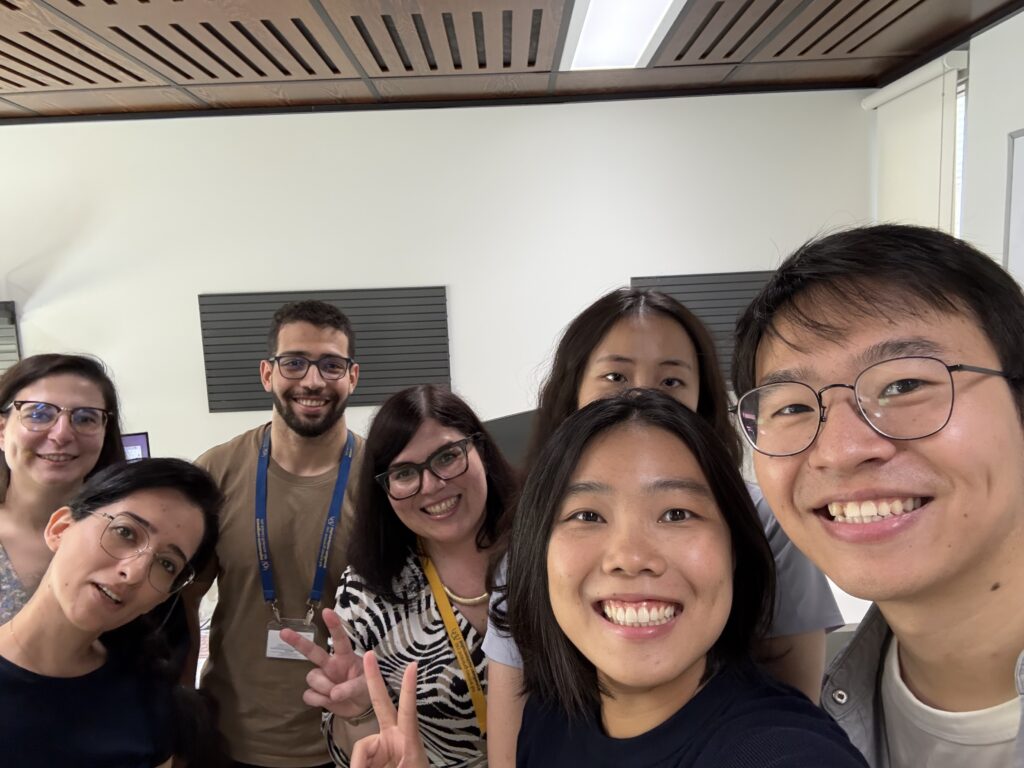
Pictured above: One of Hechuan’s favourite moments taken at CIRES headquarters. L to R: Visiting PhD researcher Eleni Ilkou, CIRES PhD researchers Mehrnoush Mohammadi, Elyas Meguellati, CIRES Centre Manager Kate Aldridge, CIRES PhD researchers Hongliang Ni, Zirui (Alice) Tan, and Hechuan Wen.
View all resources