A/Prof Renata Borovica-Gajic, Inaugural Winner, Resilient Data Engineering Award

The inaugural winner of the Resilient Data Engineering Award is Associate Professor Renata Borovica-Gajic from the University of Melbourne.

Associate Professor Borovica-Gajic has developed adaptive and self-driving database technologies that transform how complex data systems are prepared, accessed and analysed, reducing the time from data availability to actionable insights and uncovering hidden patterns within complex datasets.

Her work spans secure AI-enabled infrastructure, automated data engineering and resilient analytics platforms for healthcare, science, government and industry. Her contributions demonstrate sustained leadership in advancing reliable, adaptive and secure data systems.

Congratulations to Associate Professor Borovica-Gajic!

The Resilient Data Engineering Award is proudly sponsored by The University of Queensland and the ARC Training Centre for Information Resilience (CIRES), with support from Adelaide University, Monash University, The Australian National University, The University of Western Australia, UNSW, the University of Melbourne and the CORE Computing Research and Education Association.
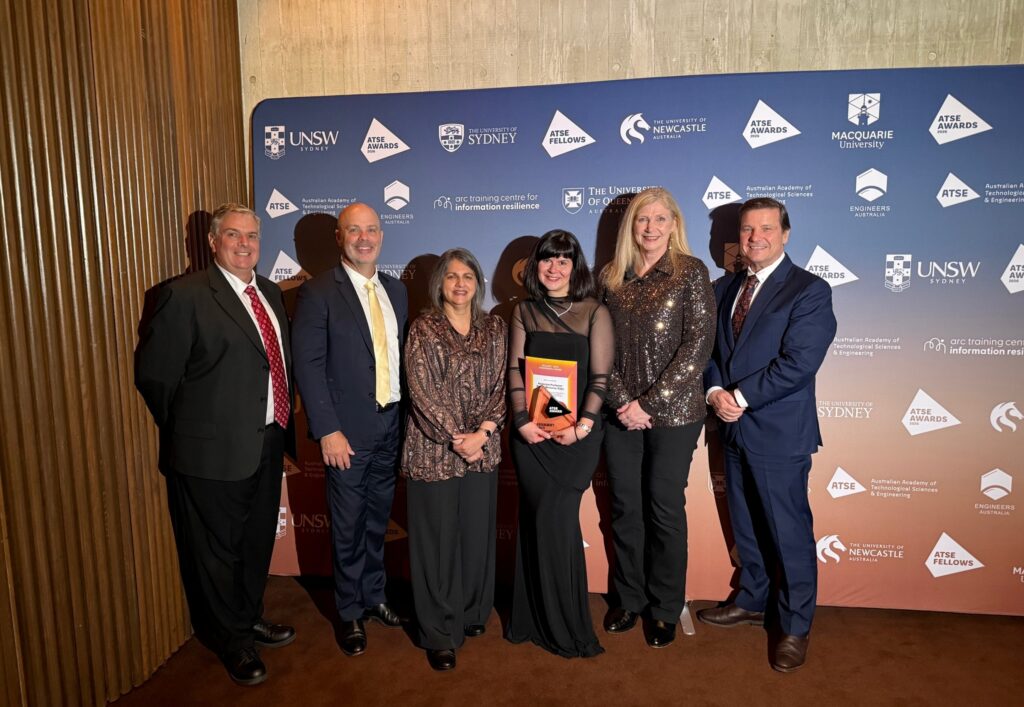
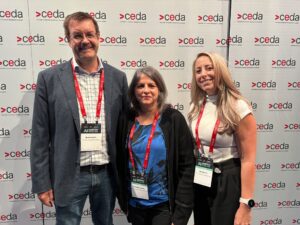
Left to Right: Neil Readshaw (Anonyome Labs), Simon Bush (ServiceNow), Professor Shazia Sadiq (CIRES Centre Director), A/Prof Renata Borovica-Gajic (The University of Melbourne), Dr Sue Keay (UNSW AI Institute), Stan Gallo (BDO Australia)

CIRES at AI Leadership Summit 2026

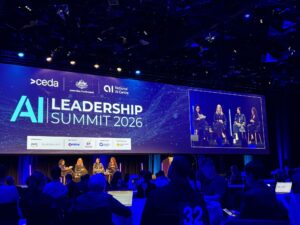
CIRES Centre Director, Professor Shazia Sadiq, attended the AI Leadership Summit one of the most influential AI events of the year designed for leaders, organised by CEDA (Committee for Economic Development of Australia) and the National AI Centre.

A few highlights:

  • AI isn’t just a technology issue. Every leader needs to understand it and take accountability for how it’s used, but we all have a role to play in how AI is adopted and used.
  • The real productivity opportunity isn’t simply adding AI to what we already do. It’s about redesigning work and processes, while keeping human judgement and agency at the centre.
  • The breadth of AI capability at The University of Queensland, and the opportunity we have to bring that together across disciplines, connect it with industry and play a leading role in where Australia goes next!

UQ Business School’s AI-First Strategy Masterclass

How can leaders move AI beyond isolated projects and embed it across the organisation?

Explore how to take this next step at UQ Business School’s AI-First Strategy Masterclass on Friday 6 November, led by globally recognised digital innovation expert Professor Youngjin Yoo, FBA from The London School of Economics and Political Science (LSE).

Drawing on Professor Yoo’s work on the Runtime Economy, you’ll learn how continuous sensing, learning and action can reshape organisational strategy, operating models and governance.

Professor Yoo will be joined by data strategy expert and CIRES visiting expert, Professor Christine Legner from HEC Lausanne – The Faculty of Business and Economics of the University of Lausanne, alongside CIRES Chief Investigator, Dr Ida Asadi Someh and Dr Frederik von Briel.

Youngjin’s work on the Runtime Economy challenges the assumptions the modern economy is built on. For centuries, value has rested on scarcity. Value falls as supply rises, systems are designed to produce the same result every time, and organisations exist to reduce the cost and complexity of exchange. Generative AI overturns each of these. It creates value through abundance, context and variation, producing unique, situation-specific outputs at runtime rather than replicating a fixed design. In this world, more supply can create more value, not less, and firms exist to create and capture value from abundance.

Christine brings the foundation every AI ambition depends on: data that is actually ready for AI. Without AI-ready data, agentic AI cant work at enterprise scale. Drawing on more than 100 sources and close collaboration with the 20 global partner companies of the Competence Center Corporate Data Quality, including BASF, Bosch, Nestlé, SAP and Siemens, her team has developed a practical definition of AI-ready data and six dimensions for assessing it.

Through real-world cases, this half-day masterclass will help you develop an AI-first strategy, scale AI responsibly and translate emerging technology into lasting value.

Learn more and register


Welcome Professor Christine Legner from HEC Lausanne

It is our pleasure to welcome Professor Christine Legner from HEC Lausanne – The Faculty of Business and Economics of the University of Lausanne to CIRES at The University of Queensland.

Over the next month, Christine will be collaborating with CIRES researchers A.Prof. Ida Asadi Someh, Prof. Marta Indulska, Prof. Shazia Sadiq, and Lufan Zhang, sharing her expertise in information systems, data management, and digital transformation while engaging with our research community.

We are also delighted that she will be joining the 11th Information Systems Foundations Workshop hosted at UQ on 2-3 November 2026.

“I am very excited to progress the global data repurposing study we have started together with the ARC Training Centre for Information Resilience (CIRES) and the Competence Center Corporate Data Quality (CC CDQ),” said CIRES Centre Director Professor Shazia Sadiq.

We look forward to the conversations, collaborations, and knowledge exchange her visit will bring.

Welcome Christine!

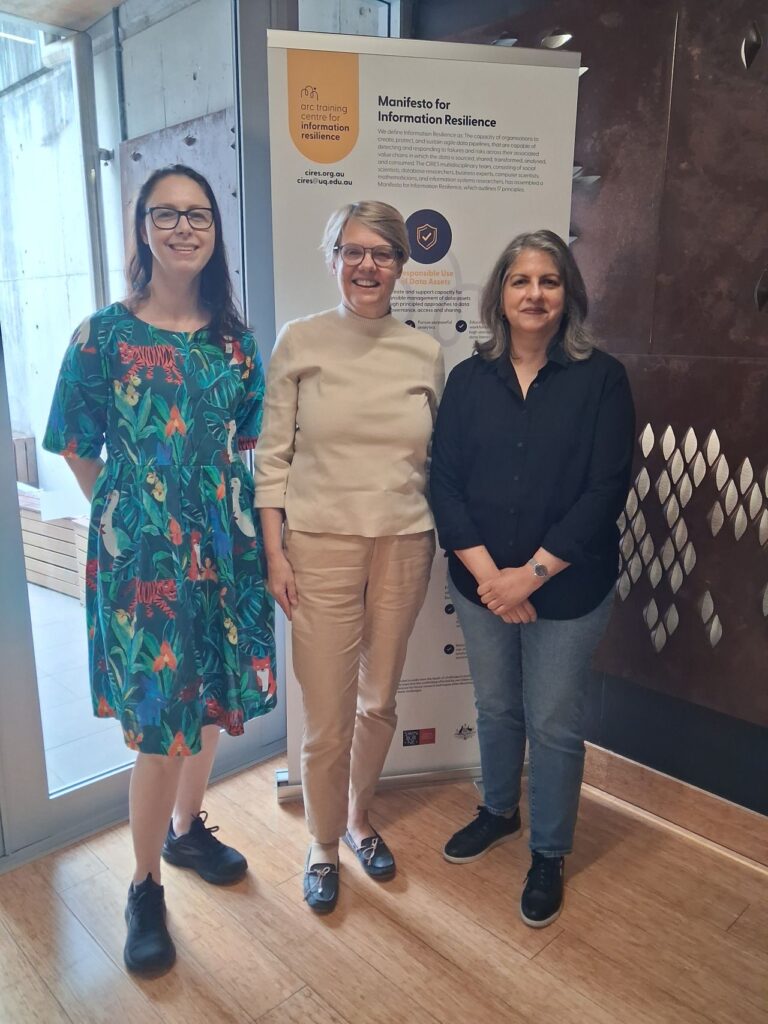
Pictured (left to right): Prof. Marta Indulska, Prof. Christine Legner, and Prof. Shazia Sadiq at CIRES HQ

Congratulations to PhD Graduate Dr Hechuan Wen

We are excited to profile our CIRES graduate, Dr Hechuan Wen, who celebrated his PhD graduation last week at The University of Queensland’s graduation ceremony in Shanghai.
How can organisations make informed decisions when the data available are limited, changing, or incomplete?

This question became the focus of CIRES PhD graduate Dr Hechuan Wen’s thesis, Advancing Causal Effect Estimation: From Training Data Expansion to Estimator Design, supervised by Associate Professor Rocky Chen, Professor Hongzhi Yin, Dr Li Kheng Chai, and Professor Shazia Sadiq.

Rather than simply predicting what is likely to happen, Hechuan studied how AI can estimate what would happen to an individual or community under a particular intervention, such as a healthcare policy, treatment, or public service. His research focused on making causal effect estimation more reliable and practical when real-world data are imperfect. Specifically, he addressed three key challenges: identifying the most informative data when labelling resources are limited; maintaining reliable estimates when data distributions change or important variables become unavailable; and quantifying uncertainty when causal effects are estimated from complex, interconnected data.

Reflecting on the importance of building connections throughout his PhD journey, Hechuan offers the following advice to current and future research students:

“My advice would be to stay focused on a meaningful research problem but remain open to where the PhD journey may take you. Research rarely progresses exactly as planned, and some of the most important learning happens when methods fail, data are imperfect, or questions need to evolve. I would also encourage students to look beyond publications and technical performance. Working with partner organisations, domain experts, and researchers from different backgrounds can broaden your perspective, strengthen the relevance of your research, and open opportunities that extend well beyond the PhD.”

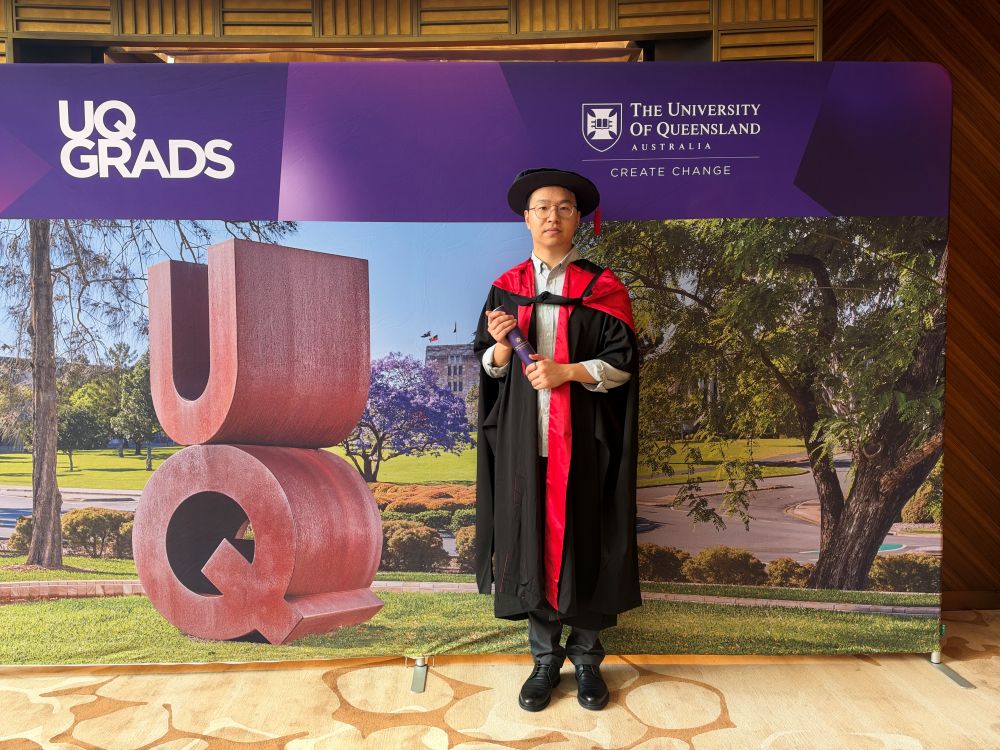
Pictured above: Dr Hechuan Wen, UQ Graduation Day in Shanghai, October 2026. 

Read Hechuan’s Full Story

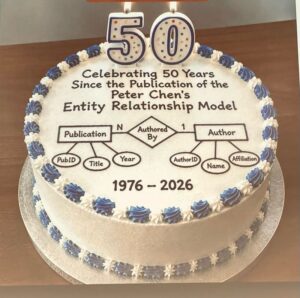
The Entity-Relationship (ER) Model turns 50!

Peter Chen’s paper “Entity-Relationship: a unified view of data” is turning 50 years old!

In the middle of the database wars in the 70s, Peter wrote a long-lasting classic contribution: a natural-language inspired minimalistic model to capture domain concepts in a way that was independent of technology.  Peter’s paper even had the foresight of prescribing levels going from knowledge about the world to computational independent data models, platform independent and platform specific models (his levels 0-3).

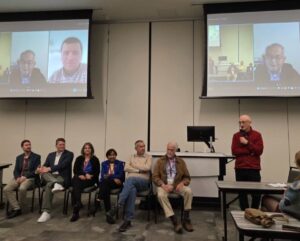
As a tribute, a panel with conceptual modelers belonging to several generations and active over these 50 years was convened at the 45th International Conference on Conceptual Modeling, 5-8 October 2026, Memorial University of Newfoundland, Canada.

The panel included Terry Halpin (creator of the ORM language and 2026 Peter Chen Award Laureate), Sudha Ram (2021 Peter Chen Award Laureate), Oscar Pastor (2016 Peter Award Laureate), CIRES Centre Director Shazia Sadiq, Roman L., Simon Curty (2026 David Gries Awardee for contributions to Conceptual Modeling and Programming), Giancarlo Guizzardi, and, of course, the one and only Peter Chen (unfortunately, joining remotely).

Shazia says: “A privilege to have the opportunity to speak alongside such distinguished scholars to pay tribute to Peter and celebrate 50 years of impact of the ER diagram.”


Exchange with Institute for Digital Innovation (IDI) Germany

Institute for Digital Innovation (IDI) PhD candidate Nils Riekers recently travelled to The University of Queensland for a research stay at the ARC Training Centre for Information Resilience (CIRES), working with CIRES CI Associate Professor Rocky Chen and his research group.

Earlier this year, IDI hosted Rocky at Hochschule Neu-Ulm for a talk on combating social media misinformation. Now Nils made the trip to Brisbane for a short research stay, continuing the collaboration on multimodal multi-agent systems for hate speech detection.

The visit, funded by a seed grant from the Bavaria-Queensland Research Alliance (PI at HNU: Dr. Adeline Frenzel-Piasentin), enabled an intensive exchange on the joint project. Having both sides visit each other in person made a real difference: it allowed for focused, hands-on collaboration that is hard to replicate remotely and has given the project strong momentum going forward. We’re looking forward to the next stages of this collaboration. The stay concluded with a final presentation to Rocky’s group.

Many thanks to Rocky and his team for the warm welcome and to everyone who made this mutual exchange possible!